





Ntuziaka zuru oke maka ime ime ọgbara ọhụrụ
Some of the most striking curtains in modern hotels and restaurants have never been washed, will never fade, and wouldn’t burn even if you held a lighter to them. They look like silk. They move like silk. They’re made of metal.
That’s the strange thing about metal mesh curtains everyone has seen one, almost nobody knows what they’re looking at. And when a designer or contractor decides they want one, they hit a wall: the information online is either a sales page or a copy of a copy of a sales page.
This article is the other thing. We manufacture these curtains in Foshan, China, and this is what we’d tell you if you walked into our factory and asked: how they’re built, which type is which, what to check before you order, and the mistakes that cost buyers money.

Mbụ, What Are You Actually Looking At?
A metal mesh curtain is a hanging screen built from thousands of small metal pieces, rings, spirals, or linked wires connected loosely so the whole thing drapes. That’s the part that surprises people. There’s no trick, no fabric backing. It’s metal all the way through, engineered to behave like cloth.
Because the connections are loose, the curtain gathers, folds, and sways with moving air. Because it’s metal, it does things no textile can:
- It can’t burn. Class A fire rating, which is exactly why hotels, theaters, and casinos use it where fabric would fail inspection.
- It doesn’t fade, rot, or hold stains. Nobody washes it. Nobody replaces it.
- It lasts. Our oldest installations are past 15 years and still hanging.
The Three Builds and the One Everyone Confuses
There are three ways to construct a metal mesh curtain, and suppliers online mix up the names constantly. Here’s how to tell them apart in the real world.
Coil Drapery (Spiral Mesh)
Continuous wire spirals hooked into each other, like a spring mattress unrolled into a curtain. This is the lightest, flowiest build, it moves when someone walks past. If the photo you’re looking at has soft, fabric-like waves, it’s almost certainly coil drapery. Around 2–6 kg/m², and the wire is usually 0.5–1.2 mm.
Chainmail (Ring Mesh)
Individual rings linked one at a time yes, the same idea as medieval armor. It’s denser, heavier, and far more glittery because every ring is a tiny reflector. Around 4–10 kg/m². This is the build behind most of those dramatic gold walls you see in hotel receptions and luxury retail.
Here’s the confusion: half the internet calls coil drapery “chainmail” and vice versa. If a supplier can’t clearly tell you which construction their product uses, be careful.
Chain Link Curtain
Bigger diamond-shaped links, open and airy. Less fabric, more “screen.” You choose this one when you want division and shimmer but still need airflow and sightlines space dividers, semi-transparent partitions, exterior shading.
Build | Transparency | How it moves | The mood |
Coil drapery | Medium | Flows like silk | Soft, elegant |
Chainmail | Low–medium | Heavy drape, high shimmer | Luxurious, bold |
Chain link | High | Light swing | Open, industrial |
Where These Curtains Actually End Up
We ship to hotels, restaurants, bars, retail stores, and offices. The pattern is consistent:
Hotel lobbies and atriums. The classic. One large golden installation over a reception desk does more for a lobby than almost any other single material and it photographs well, which designers quietly admit matters now.
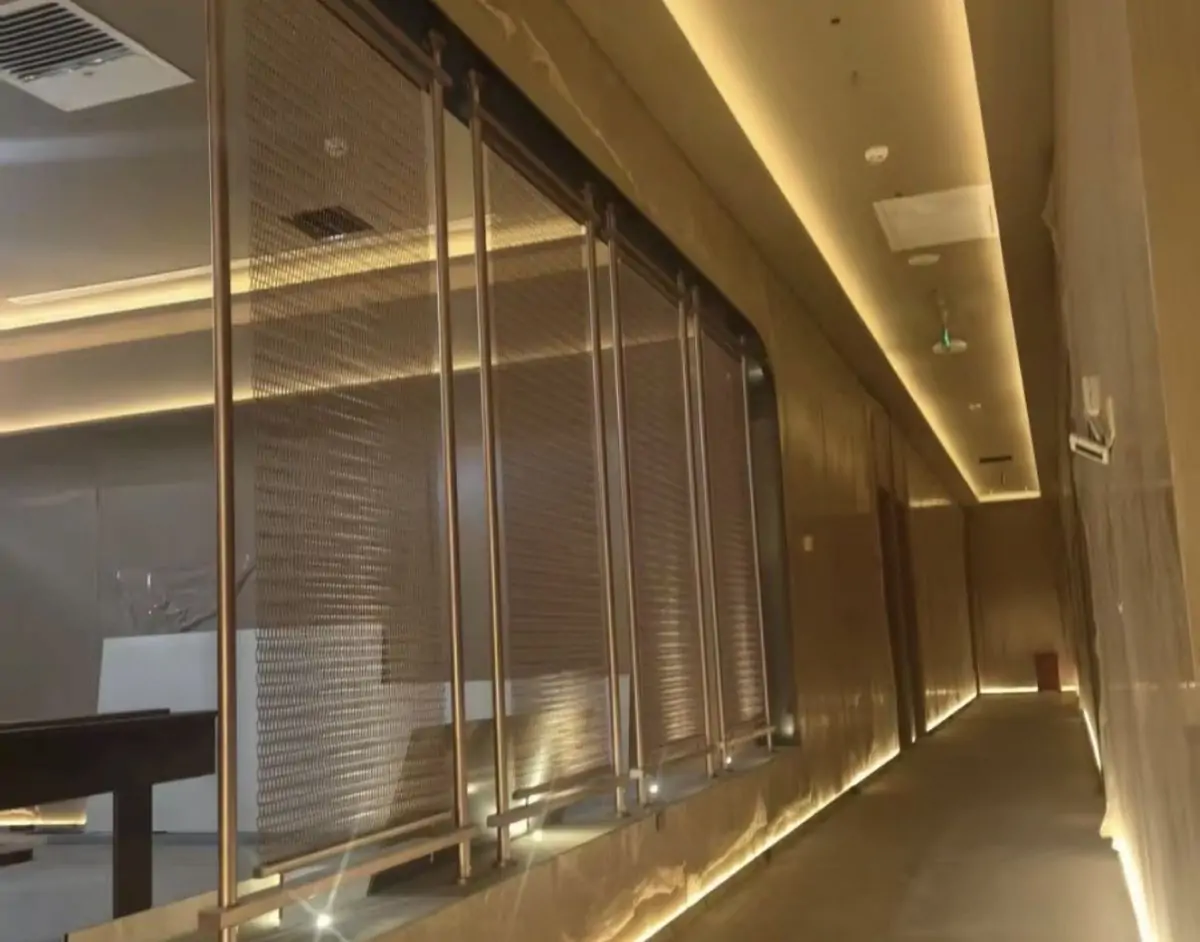
Dividers. Split a restaurant from its bar without a wall. Guests feel the separation; light and air keep moving.
Ceilings. Wavy coil drapery overhead hides ducts and pipes while adding movement.
Windows and facades. Sun control without killing the view. Outdoors, igwe anaghị agba nchara 316 and anodized aluminum handle rain and coastal air fine.
Fireplace screens. One of chainmail’s oldest jobs spark protection that doesn’t look industrial.
The Mistakes We See Buyers Make
This is the section nobody else writes, and it might save you the most money.
1: Ordering flat. A metal mesh curtain should be 150–200% of your track width so it falls into folds. Order it “exact to size” and you’ll get something that looks like a metal wall. We’ve had to remake orders over this.
2: Not checking the ceiling load. Chainmail at 8–10 kg/m² is genuinely heavy. A 20 m² installation is 160–200 kg hanging from your ceiling. Confirm the structure before you fall in love with the heavy option.
3: Comparing quotes with different specs. A cheaper quote usually just means thinner wire or lower fullness. When you compare suppliers, line up wire diameter, aperture, fullness ratio, and weight then compare prices.
Mistake 4: Skipping samples. Gold from PVD coating, from brass, and from copper are three different golds under warm lobby lighting. Order physical samples. Every serious factory will send them.
Materials and Finishes, What Your Options Really Are
The base metal decides durability and cost; the finish decides the look.
Igwe anaghị agba nchara 304 is the default for interiors. 316 if you’re coastal or humid. Aluminom at roughly a third of the weight is the smart pick for big ceiling installations. Brass and copper give you natural warm tones that age beautifully and cost accordingly.
For finishes: natural metallic, anodized colors (mainly aluminum), or PVD coating. PVD bonds the color at a molecular level gold, rose gold, black, bronze and it won’t peel the way paint does.
Custom printed designs. This one surprises people. Full-color artwork patterns, landscapes, even detailed characters can be printed directly onto the metal surface. A restaurant chain can turn a divider into a branded feature wall. A hotel can match the curtain to its theme.
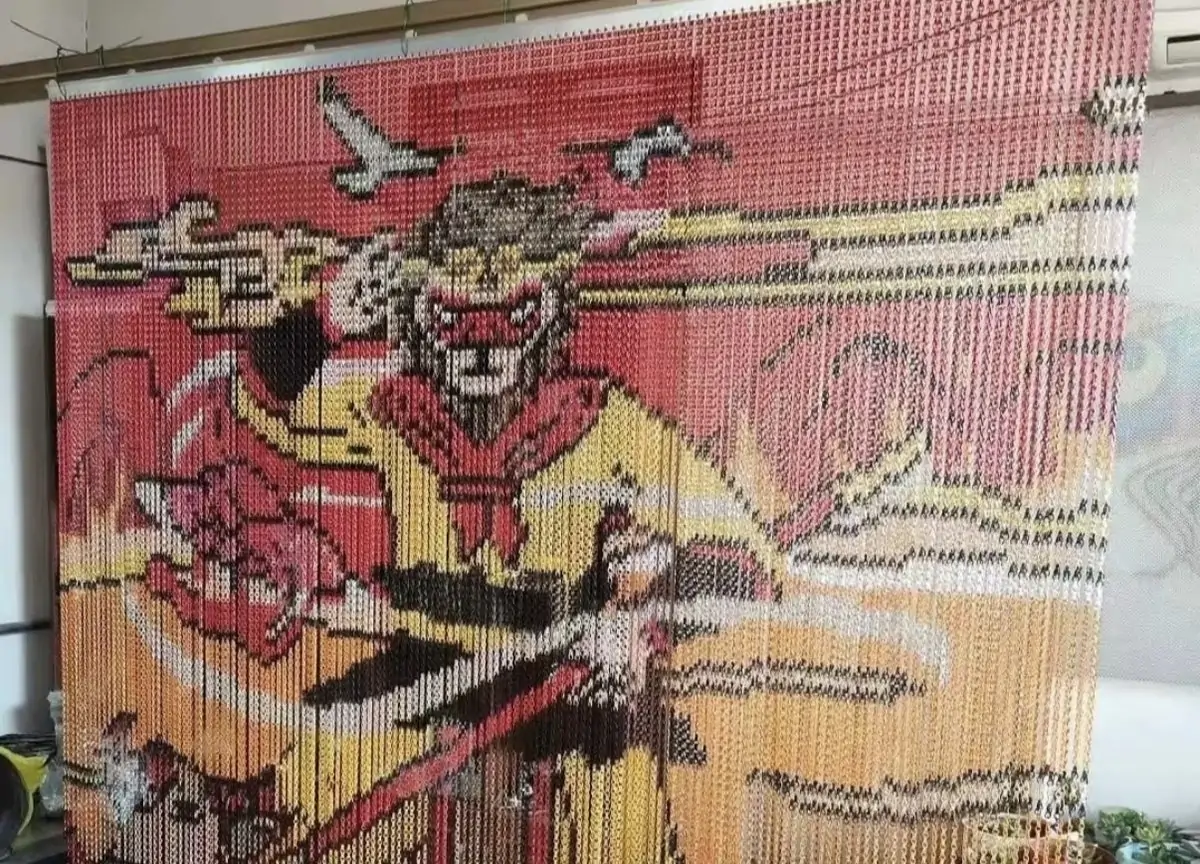
Custom printed metal mesh curtain with a Monkey King design
What to Put in Your Inquiry (So You Get the Right Quote)
When you message a manufacturer, include these five things and you’ll get a real answer instead of a sales pitch:
- Dimensions: width and drop of the opening, and whether you want it flat or with fullness (say 150–200%).
- Build type: coil drapery, chainmail, or chain link. A reference photo works if you’re not sure.
- Material and color: e.g., stainless steel with gold PVD, or natural brass.
- Indoor or outdoor: this decides the steel grade.
- Track needs: straight, curved, or motorized. Curved tracks cost more but they’re what makes wave-shaped installations possible.
Installation and Living With It
Installation is a track-and-hang job, honestly simpler than people expect. Panels arrive with the top edge finished for the track. Two installers typically hang 20–30 m² in a day. Motorized tracks add an electrician that’s the extent of the complexity.
Maintenance is close to nothing: dust it with a soft brush or a vacuum on low. Near a restaurant kitchen, an occasional wipe with diluted neutral detergent brings back the shine. Compare that with fabric curtains in commercial spaces professional cleaning two to four times a year, full replacement every five to eight years.
Ajụjụ a na-ajụkarị
How much does a metal mesh curtain cost? It depends on material, wire diameter, and fullness ratio. Aluminum coil drapery is the most economical; brass chainmail is the premium end. As a rough range, expect US$30–120 per m² send your specs to manufacturers for accurate quotes.
Can these curtains go outdoors? Ee. Igwe anaghị agba nchara 316 and anodized aluminum handle rain, iru mmiri, and coastal air, which is why they’re used as facade shading and exterior screens. Just confirm the material grade with your supplier for your specific climate.
Are metal mesh curtains fire-safe? Completely. The mesh is non-combustible with a Class A fire rating the main reason it’s approved in hotels, theaters, and public buildings where fabric curtains fail fire codes. No flame-retardant treatment is ever needed.
How long will one last? With normal indoor use, 20 years or more. The metal doesn’t fade, stretch, or degrade, and maintenance is occasional dusting. It’s a one-time investment rather than a recurring cost like fabric.
Can I get custom colors and sizes? Yes custom is the standard, not the exception. Panels are cut to your exact width and drop, and PVD coating offers gold, rose gold, black, bronze, and custom tones. Always request physical samples before confirming a full order.
Isi ala
A metal mesh curtain sits in a rare category: decorative, functional, fire-safe, and nearly permanent at the same time. Get the build type right (coil drapery, chainmail, or chain link), order it with fullness, check your ceiling load, and ask for samples do those four things, and it’s very hard to go wrong.
Working on a hotel, ụlọ oriri na ọṅụṅụ, or retail project? Browse our decorative mesh range or explore our decorative metal wire mesh options.
And if you have a Pinterest photo of your own send it with your dimensions. We’ll tell you exactly which build it is, quote it, and mail you samples before you commit to anything.